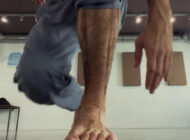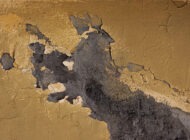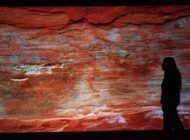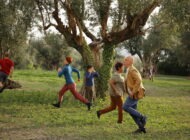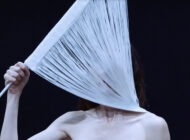

Il video deriva da un’opera performativa di Secondo Nome, tuttora in fase di produzione e sviluppo, centrata su una sorta di “human watching” circoscritto al lungomare di Ostia. Uno sguardo neutrale su un catalogo delle variazioni dell’Andare. Lì gli elementi in gioco sono un performer (Nunzio Perricone), un artista sonoro (Alessandro Floridia), una selezione di testi (H. De Balzac, R. Walser, M. Merleau-Ponty, C. Di Fazio, F. Careri, R. Solnit) e la proiezione su schermo di riprese del lungomare: qui, nel video di Ivan Gasbarrini, il montaggio costringe a un dialogo serrato la dimensione del continuo con quella del frammento, crea schemi ritmici che si alternano tra forza e vulnerabilità, tra anatomia e cultura, tra il tempo del singolo e quello della collettività, affidando alla luce al buio e ai suoni il compito di rendere visibile anche ciò che rimarrebbe implicito.
Nell’atto del camminare, scheletro, memoria, abitudine e desiderio si intrecciano fino a rendere inseparabili la dimensione biologica e quella politica. Ogni passo registra un equilibrio provvisorio tra vincoli fisiologici, biografia e possibilità di cambiamento, ogni corpo custodisce una propria modalità di attraversare il mondo. Macchina Reale, nella forma del video come in quella performativa, si sofferma su questa soglia: condizione sospesa, dove il corpo si manifesta insieme come macchina, archivio e luogo di immaginazione, dove l’andare è una pratica condivisa, ma nessun corpo attraversa, o può attraversare, il mondo allo stesso modo. Tra impulso e adattamento, meccanica e immaginazione, il movimento rivela la continua negoziazione tra ciò che ci determina e ciò che, nelle differenze, può ancora trasformarci.
The video originates from a performative work by Secondo Nome, currently in development, centered on a form of “human watching” focused on the seafront of Ostia. A neutral gaze observing a catalogue of variations of Going. The work brings together a performer (Nunzio Perricone), a sound artist (Alessandro Floridia), a selection of texts (H. de Balzac, R. Walser, M. Merleau-Ponty, C. Di Fazio, F. Careri, R. Solnit), and projected footage of the waterfront. In Ivan Gasbarrini’s video, the editing forces a tight dialogue between continuity and fragmentation, shaping rhythmic patterns that oscillate between strength and vulnerability, anatomy and culture, the time of the individual and that of the collective. Light, darkness, and sound are entrusted with the task of making visible what would otherwise remain implicit.
In the act of walking, skeleton, memory, habit, and desire intertwine until the biological and the political become inseparable. Each step records a provisional balance between physiological constraints, biography, and the possibility of change; each body carries its own way of crossing the world. Macchina Reale, both in its video form and in its performative dimension, lingers on this threshold: a suspended condition where the body appears at once as machine, archive, and site of imagination; where walking is a shared practice, yet no body moves through the world in the same way. Between impulse and adaptation, mechanics and imagination, movement reveals the ongoing negotiation between what determines us and what, through difference, can still transform us.